
Is an AI capable of running a company or replacing my entire team? This is one of the questions I encounter when people realize I have some experience and control over everything related to Artificial Intelligence.
Because yes, AI is capable of writing texts, analyzing documents, generating images, programming applications, and helping us make decisions. In this, I think we will largely agree, but today, we are entering a new stage: that of Artificial Intelligence Agents.
Until now, most of us used Artificial Intelligence as a tool we asked something of and expected an answer from. We wrote a prompt, got a result, and, to a greater or lesser extent, used that response to continue with our work.
Why do Artificial Intelligence agents change the rules of the game?
We are no longer talking solely about an AI that answers questions, but about systems capable of receiving a goal, interpreting the context, deciding what actions to take, and using different tools to try to achieve a result.
And I use the word "try" completely intentionally. Because an Artificial Intelligence agent is not an infallible digital employee close to a winged unicorn capable of solving all the problems of our company or project. An AI agent does not magically replace a team and, much less, turn a poorly designed process into an efficient one simply by adding Artificial Intelligence to it.
In this post, I will tell you what an Artificial Intelligence agent is, how it works, how it differs from traditional automation, and how you can use AI agents to create real value within a company without getting carried away by hype or trends.
What is an Artificial Intelligence agent?
An Artificial Intelligence agent is a system capable of receiving a goal, analyzing ALL available information, making certain decisions, and executing a series of actions to TRY to complete a task.
The main difference compared to traditional generative Artificial Intelligence lies in the ability to act, figure things out, and make decisions in the process of completing the requested task.
When you use a conventional AI chat like ChatGPT or Gemini, you are usually the one directing the process. You ask a question, review the answer, provide new information, and decide what the next step should be.
In an agentic system, part of that process can be delegated.
For example, instead of asking an AI to draft an email, you could ask it to review incoming messages, identify which ones contain a commercial inquiry, look up information about those companies, prepare a personalized response, and leave the emails saved as drafts for a person to review.
The agent doesn't just generate text. It has a goal, consults different sources of information, uses tools, and completes a sequence of actions.
But WATCH OUT FOR THIS!
Just because a system can act more autonomously doesn't mean we should allow it to do whatever it wants without supervision.
Autonomy is not a switch that can only be on or off. It is more like a thermostat that we need to adjust depending on the importance of the task, the associated risk, and the system's ability to recover from a potential error.
How does an AI agent work?
Although explained this way and viewed from a certain distance, an agentic system might seem almost magical, AI agents are usually formed by a combination of quite understandable elements that do not escape the basic concepts necessary to allow you to control any artificial intelligence or artificial intelligence system.
First of all, it needs a goal.
That goal can be as simple as classifying requests received by the customer service team or as complex as researching a market, detecting business opportunities, and preparing a report with conclusions, or taking an idea from scratch to create a minimum viable product. The limit is in our ability to imagine how the fundamental value of artificial intelligence agents can help us meet our objective.
Once we have the goal, comes one of the parts where we humans fail the most when interacting with Artificial Intelligence, whether agentic or traditional generative AI. All AIs need good context. That is, information about the company, its products, its users, its processes, the rules it must respect... In short, deep knowledge that serves not only to fulfill the goal we have set for it, but also to do so in the right way.
Furthermore, at this point of generating context, an AI agent can have access to different tools. For example, a search engine, a database, email, the company CRM, a spreadsheet, or an internal application that allows it to feed on the necessary information to cover our objectives and expectations regarding the expected result.
Based on these elements, the system plans and executes different actions until it obtains a result or reaches a point where it needs human intervention to validate it or give it more context to continue with its task.
In conclusion, we could summarize the process of agentic AI as follows:
Goal → context → decision → action → result review.
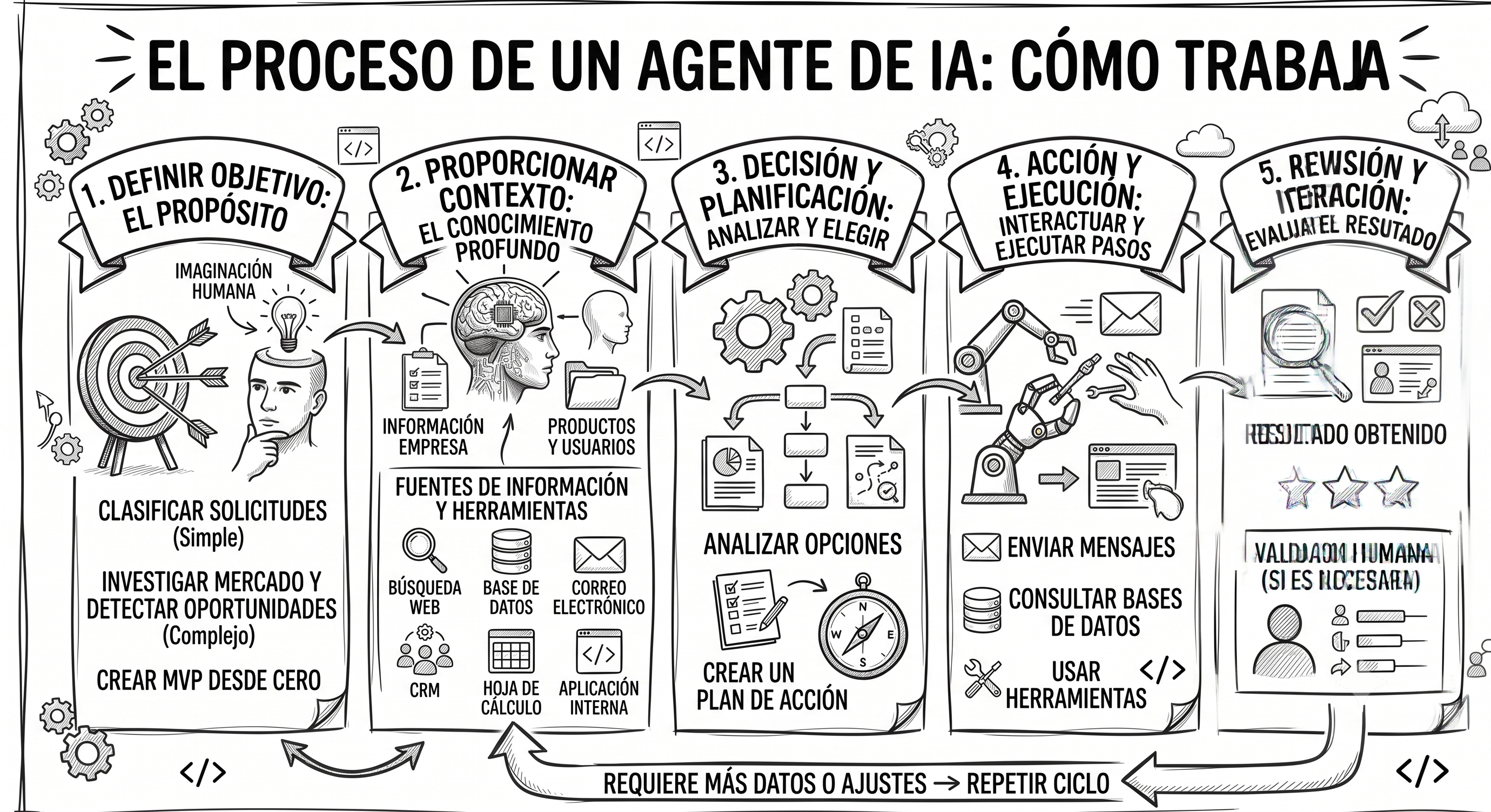
What is truly interesting is that this cycle can be repeated multiple times and is not linear. As I mentioned a few lines above, the agent can stop, for example, at the context part and execute some necessary actions so that this context grows and helps it better achieve the final goal we have defined for it.
A simple example: Imagine an agent in charge of researching potential clients. First, it could search for companies that meet certain criteria. Then it would review their websites, identify their activity, check if they fit the ideal customer profile, and finally, prepare a prioritized list.
If during the process it discovers that a company does not meet the requirements, it can discard it and move on to the next one.
This makes agents especially useful for tasks that require multiple steps, different sources of information, and small intermediate decisions.
Is an AI agent the same as an automation?
The short answer is no, although both concepts can work together.
Traditional automation follows predefined rules. The process always follows the same path. If A happens, the system executes B.
For example: when a person fills out a form, saves their data in the CRM, and sends a confirmation email.
However, an Artificial Intelligence agent has a greater capacity to interpret situations that are not exactly identical, decide what the next step might be, and even detect whether that next step requires human intervention or not.
For example, it could analyze the message written in the form, detect the user's intent, assess the urgency of the request, and decide which person or department it should be assigned to.
Process automation is an ideal mechanism to streamline company processes when they are predictable, the rules defining them are perfectly known, and we want to execute that process over and over again in a much more efficient, and often economical, way for the company.
Agents are interesting when there is a certain amount of variability, when information is not completely structured, or when it is necessary to make small decisions during the process.
That is why I suggest that if you are reading this post because you want to implement an AI agent system in your company, business, or venture, you carefully evaluate first what you really need, since using AI agents to do simple process automations is like using a sledgehammer to crack a nut. Besides, the bill you get for setting up an AI agent won't be exactly small.
Therefore, analyze your case well or ask an expert, for example, in Product Design specialized in AI, to analyze your case thoroughly because if a simple rule solves the problem reliably, you don't need to add a layer of Artificial Intelligence. You would be increasing cost, complexity, and uncertainty without necessarily getting more value.
What can a company use AI agents for?
The fundamental value of artificial intelligence agents appears when they help reduce the effort of a task, improve the quality of a result, speed up a process, or allow something to be done that was previously unfeasible for a computer system because its complexity required a person evaluating a bunch of variables to make decisions.
Agents can be used in practically any area of a company and can solve practically any problem you set your mind to. BUT before detailing some areas where AI agents can be used for a company, I feel the moral need to refer back to the previous point. Analyze well whether you really need an AI agent for your company or a simple automation, as it will save you a lot of grief, headaches, and money for your company... you've been warned 🙃
Now, let's look at some examples.
AI agents for market research
An agent can search for information about a sector, analyze competitors, detect patterns, and organize results to make review easier.
This does not replace professional market research, but it can help us build an initial picture of the terrain and detect questions worth investigating in greater depth.
The key is not to confuse information with knowledge.
The agent can gather hundreds of data points, but a person still has to evaluate what they mean, how they affect the company, and what decisions can be made based on them.
👉 TIPS & TRICKS: What many people don't know is that you don't need to develop this specific use case in your company; others have already dedicated the effort to creating agents oriented toward this purpose. A good use of tools like Perplexity, Gemini, or even ChatGPT itself can help you complete this task because, although for the average user they are still simple chats, what operates these services underneath is a system of agents... SPOILER: developed by the largest companies in the world and, at least as I write these lines, with free usage versions.
Agents for customer service
An agent can classify requests, retrieve information from the knowledge base, prepare responses, and detect cases that need human intervention.
This allows the team to spend less time on repetitive queries and more energy on solving complex situations.
But we have to be extremely careful.
An agent that answers a simple question incorrectly can cause a minor annoyance. An agent that gives wrong information on sensitive topics such as a payment, a cancellation, or a contractual condition can create a much more serious problem.
That is why it is essential to define what an AI agent can and cannot solve, make it clearly see which situations it must escalate and what decisions it can never make on its own.
AI agents for product teams
Product teams can use agents to organize feedback, analyze interviews, group requests, detect recurring issues, prepare documentation, and generate PRDs for technology teams...
Imagine you have hundreds of comments coming from support, surveys, interviews, and reviews.
An agent could group all that information, detect common themes, and relate them to specific parts of the product.
This does not mean the agent should decide the roadmap.
Prioritizing a product requires understanding strategy, business, team capabilities, users, and the company's context. AI can help us sort the pieces and even create complex pieces of information quite accurately in a matter of seconds, greatly optimizing a product manager's workflow, but the decision still requires judgment, and judgment is still provided today by people.
Agents for commercial processes
An agent can research companies, enrich contacts, prepare meetings, or create personalized drafts.
The danger appears when we use this capability to mass-produce messages without adding any value.
Automating noise usually achieves only one thing... generating more noise.
A good sales agent should help people better understand the customer and prepare more relevant interactions, not become an email-sending machine that nobody wants to receive.
Agents for internal operations
AI agents can also be used to review documents, update systems, prepare reports, check that certain tasks have been completed, or coordinate information between different tools.
In many cases, these internal applications are a magnificent starting point because they allow learning in a more controlled environment with less direct impact on customers, since ultimately internal processes that are often complex are automated, and an agent can take away all the most technical work of writing, finding documentation, and aggregating all information disseminated across different platforms into a single document...
This use of agents helps many people in the company understand the true value and how these systems work in the first place. Furthermore, it allows professionals to focus more on more complex tasks that require concepts like empathy, vision, or strategy for better decision-making.
💡 Personal Experience: Both professionally and for my own personal projects, this has been one of the best uses in terms of the effort involved and the reward you receive that I have detected (to date) in companies. Building a small brain to be used by an AI for a company, a specific project, or a work team is a relatively easy exercise to plan, quite simple to predict the result of and its real impact on the company, because once that brain is created, connecting it with tools like Claude exponentially changes the way teams and companies work.
How to detect a good use case for an AI agent
One of the most common mistakes in almost all companies is starting with technology instead of figuring out what the real problem is that we want to solve and then seeing how technology can help us solve that problem.
In 95% of cases, the dynamic in companies is as follows. The company discovers a new technology that is the Holy Grail and the solution to all company problems—right now the trend is agent-building tools—and automatically starts looking for somewhere to use it.
In my personal experience, the process should be just the opposite. First, you have to find a relevant problem and then evaluate whether an AI agent is the best way to solve it. This is why Product Design and a good product designer is a key role for any company.
In fact, a good product designer will ask you a series of questions that will help you detect if that use case you have in mind is the best candidate to implement an Artificial Intelligence agent system. But hey, since I am a product designer expert in innovation and artificial intelligence, here are some of the questions I would ask you in case they help you decide whether you need to plan an agent system in your company:
- Is the task you want to apply AI agents to a frequent task?
- Does that identified task consume a significant amount of the team's time?
- Does the completion of that task have a clear and predictable outcome?
- Is it necessary to consult multiple information sources to meet the objective of that task?
- Are there intermediate decisions that cannot be resolved solely with fixed rules?
- Can a person review the result before any significant impact occurs?
- Can we measure if the agent is truly improving the process?
The more affirmative answers you have, the more interesting the use case can be.
But you must also evaluate the risk.
It is not the same for an agent to make a mistake classifying an internal memo as it is to allow it to make a transfer, delete information, or send an important communication to thousands of customers.
Potential value and risk must always be on the same table, maintaining a good balance between effort and reward.
How to create an AI agent in a company
I repeat in case you didn't read it in the previous point. Creating an agent should not start by connecting tools and writing prompts. It should begin by clearly defining the process we want to improve, and only then, how we create an AI agent:
Define the goal
A goal like "improve customer service" is too broad.
Instead, "classify incoming requests and prepare a draft response using the knowledge base" is much more specific.
The clearer the goal, the easier it will be to design the system, evaluate its behavior, and measure its results.
Study how it is currently done
Before automating a process, you need to understand it.
Talk to the people who perform that task, observe how they work, identify what information they use, and discover where exceptions appear.
Many companies have processes that seem simple until someone tries to put them in writing.
Then invisible decisions, knowledge held by only one person, and small special cases that can completely change the outcome appear.
An agent built on a process we don't understand can accelerate precisely what is working poorly.
Limit its scope of action
You don't need to build an agent capable of completing the entire process from the start; you can begin with a specific part. In fact, I recommend starting with a small part of the process, evaluating the result, and when we are satisfied, moving on to the next.
For example, instead of allowing it to reply directly to customers, you can ask it to classify requests and prepare drafts.
This way, the team can review its work, detect errors, and improve the system before increasing its autonomy.
It is the exact same mindset I would apply to creating an MVP: generating the maximum possible learning with the lowest reasonable effort and risk.
Give it the necessary context
An agent will only be as good as the information and instructions available to it. It is essential that you give the agent all the necessary context, as it needs to understand what it should do, what it cannot do, where to find information, and when it should ask for help.
It is also important that sources are up to date. If the agent consults old, contradictory, or incomplete documentation, we cannot expect it to produce reliable results.
Artificial Intelligence does not automatically fix a company's clutter. In fact, if your agent's brain is well set up, what might happen is that it naturally brings to light many of the existing problems in the company, whether organizational, documentation-related, clarity in roles, processes... anyway, setting up an AI agent is, in itself, a very revealing exercise of the reality of companies, projects, and teams.
Include human supervision
Supervision should not be added at the end as an emergency measure. It has to be part of the system's design.
We must define which actions require approval, which errors should trigger an alert, and in which situations the agent must stop.
A good agent is not the one that tries to solve everything, but the one that knows how to recognize when it does not have enough information and needs the intervention of a person who can apply judgment and experience to the process.
Measure results
It makes no sense to say an agent works well simply because it completes a task.
We must evaluate the quality of the result, the time saved, the cost of the system, the number of corrections needed, and any errors generated.
Imagine an agent cuts the time needed to prepare a report in half, but a person has to review and redo almost all of its content. Maybe we aren't saving as much as it seemed.
Metrics should be related to the business goal, not solely to the agent's activity.
Can an AI agent replace a person?
This is probably the elephant in the room and one of the questions that generates the most fear and expectations in any coffee conversation or Reddit or LinkedIn thread. And my answer is clear: NO... for now.
And since selling hype is not my style, my answer is: it depends on the task, but designing an agent as a complete copy of a person is usually a bad starting point.
A job position consists of many different activities. Some are repetitive, others require empathy, context, experience, responsibility, or the ability to deal with completely new situations.
Agents can take over certain tasks, but that does not mean they understand all the work or the consequences surrounding each decision.
I think it is more useful to think of agents as a new capability within the team.
They can research, prepare, classify, check, and execute certain actions. People can provide judgment, define goals, manage exceptions, assume responsibilities, and make important decisions.
The true value is not necessarily in replacing someone, but in designing a better way of working between people and Artificial Intelligence systems.
The risks of AI agents
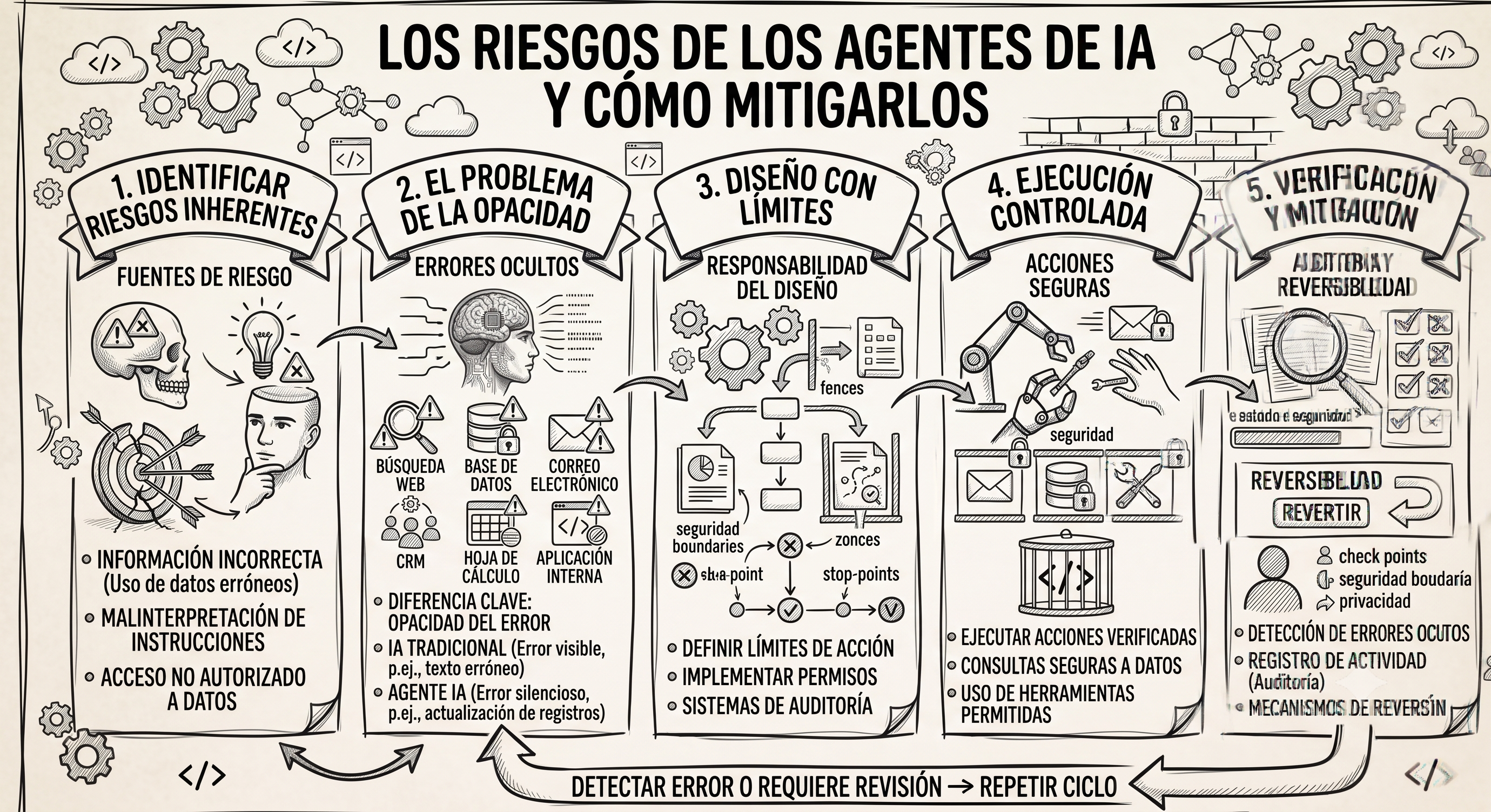
The more action capability a system has, the greater our responsibility must be when designing it.
An agent can use incorrect information, misinterpret an instruction, access data it shouldn't consult, or execute the wrong action, which can also cause a problem that is difficult to detect.
If an AI writes an erroneous text, we can see it when we read it. But if an agent updates hundreds of records silently, the error can go unnoticed until its consequences are much greater.
That is why we need limits, permissions, activity logs, and mechanisms to revert actions when possible.
We must protect company and user data, which is why before connecting an agent to internal documents, emails, or databases, we must understand what information it will use, where it will be processed, and who will have access to it.
Speed should never serve as an excuse to ignore security, privacy, or responsibility.
Start small, but start with purpose
Artificial Intelligence agents can transform the way we work, create products, and manage companies, but their value does not lie in being new, flashy, or seemingly autonomous. Value appears when they solve a real problem.
My recommendation is that you start with a specific, frequent, measurable, and relatively safe task. Design a small agent, let it work alongside a person, and carefully observe what happens.
Evaluate where it succeeds, where it fails, what information it needs, and how much effort it actually saves. Then, you can decide whether it's worth increasing its action capability, connecting it with other tools, or applying it to more important processes.
Ultimately, an Artificial Intelligence agent is not a magical solution or a digital employee that works perfectly while you sleep.
It is a new type of asset within the company.
A well-designed Artificial Intelligence agent can reduce repetitive work, speed up processes, improve analytical capability, and allow people to dedicate more energy to making decisions and creating value.
Conversely, a poorly designed AI agent can increase complexity, multiply errors, and automate processes that should never have been built that way.
As with any innovation, technology is only part of the equation and a tool that allows us to achieve our goals more easily.
The real challenge consists of understanding the problem, correctly designing the system, and finding the balance between the capability of Artificial Intelligence and human judgment.
Can Artificial Intelligence replace human beings in companies?
👉 Personal experience: a few days before writing this post, I had a conversation related to whether AI is going to take our jobs, and the person I was talking to told me something very important. We do not have enough clarity in the company or detailed, documented information for AI to do our work from end to end.
Without a doubt, the person who told me this knew very well what they were talking about and it connects very well with everything you've been seeing in this post and others I have around. Controlling AI depends on three concepts that, however simple they may be to understand, are very difficult to apply: Clarity, context, and communication.
Under those three concepts, any person or company is capable of controlling any artificial intelligence, no matter how it is sold to you. Whether it is a conversational assistant, a generative AI, or an agentic artificial intelligence system.
Furthermore, under these three premises properly applied, you will be making good use of artificial intelligence and you will be able to get the most out of this technology that has come to revolutionize the world, companies, and the way we work.
Therefore, if you don't know how to communicate your goal clearly to the AI and are unable to provide it with sufficient context, you will be generating a bigger problem than this technology, however it is dressed up, is capable of solving.
So, as a final reflection, before setting up an AI agent system for your company, think very carefully if that is what you really need. If you still come to the conclusion that it is, question whether you are clear about what you are going to use it for and whether you will be able to provide it with enough context to solve the problem you have. If not, clearly define the goal and work well on building the context, and once you have all this, set up the agent step by step, evaluating the results, iterating, and learning along the way.