We have a great idea! Let's make an MVP... Great projects usually start with a phrase similar to this. Regardless of whether you are part of a large company, want to launch a new business, innovate, or improve a feature within an existing project, an MVP or Minimum Viable Product is usually a perfect option that allows you to turn any idea or project into a tangible asset.
However, in my personal experience, there are quite a few occasions when a team sets out to build that minimum viable product and small doubts start to arise: What is an MVP really? and beyond that, how to build a minimum viable product that doesn't end up turning into a monster that devours the project or, worse yet, the team's drive and energy.
In this post I will tell you, based on the knowledge I have acquired throughout my professional career, starting from what a minimum viable product is and how to ensure an MVP doesn't cause you or your team (if you have one) to die in the shallows before you even start swimming.
What is an MVP?
First of all, an MVP should not be a solution to your business problems. Or at least, that should not be the mindset when planning this asset within the innovation process or the development of new products and services.
A minimum viable product is closer to being a strategic asset capable of validating hypotheses than a commercial product or a functional evolution within your product or business.
By this I do not mean that an MVP lacks the ability to bring value to users and the market from day one, returning part of that value as a direct economic return on your company, business, project, or venture.
There are quite a few occasions when a minimum product is made precisely to validate real market interest in your idea, allowing you to validate the hypothesis. For example, if you need to know before starting your project whether someone would be willing to pay for that brilliant new idea you've come up with, an MVP is a fundamental strategic asset in the process of turning ideas into reality, BUT it does not have to be the main purpose and, much less, the starting point from which an MVP is conceived.
How to create an MVP?
As I mentioned in the previous point, a good MVP must stem more from the mindset of being a hypothesis validator than a commercial product per se.
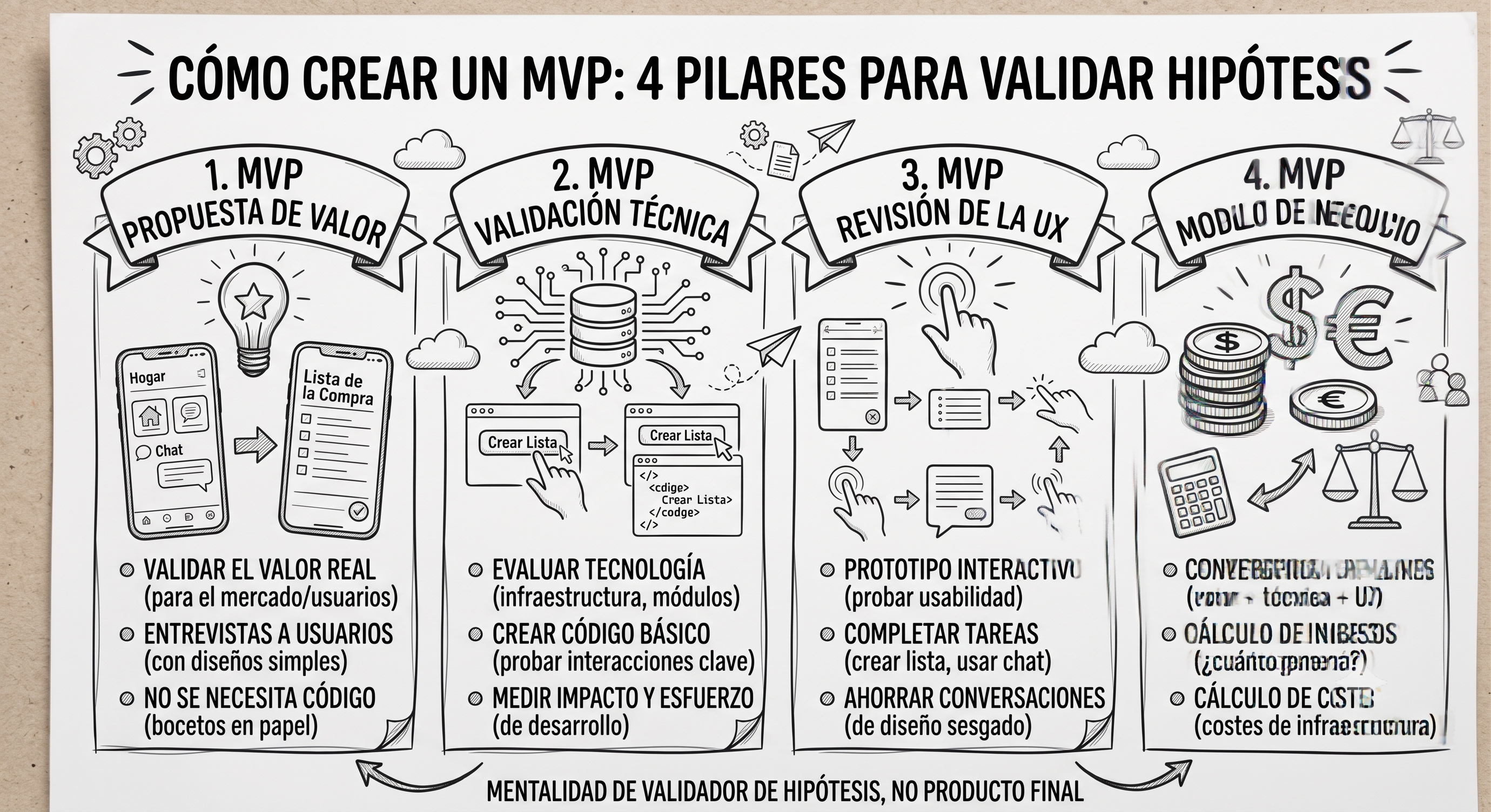
This is why, to create a good minimum viable product, it is essential to have a series of hypotheses that you want to validate on the table. Those hypotheses can be very diverse and can range from functional aspects of an existing product or service, evaluating technical implications, reviewing user experience, the value proposition of your service, or even business aspects.
Depending on the type of hypothesis you want or need to validate, the MVP will take a very different shape and complexity, which is why I will now detail the most common aspects usually evaluated in a good MVP and leave you with some ideas on how to create a minimum viable product for each case.
MVP to validate a value proposition
Any feature, product, service, or company is more or less valid depending on the value it brings to the market and its users and/or customers.
Whether you have a new idea or simply want to evaluate the value proposition of an existing product or service, you can build a minimum viable product that allows you to evaluate your idea's value proposition.
💡 Example: imagine your idea is to make an app that connects people who don't have time to go grocery shopping with people who have all the time in the world 💡
In this case, you could develop an MVP with the main screens of the app for each of the two user profiles: those who have no time and those who are going to do the shopping.
It is not strictly necessary to develop it with code; simply try making a few designs of those main screens. You can even sketch your ideas for those screens on paper—the home page, the chat where users will talk, and the grocery list that both will see.
With something as "simple" as this, presented to users, you will be able to sit down and interview each potential user profile of your app to see how they react and, most importantly, evaluate what real value they see in your idea.
MVP for the technical validation of your product or service
As I was saying, an MVP can also help us validate technical aspects of how we will develop our idea.
In many projects, doubts often arise about what the best technology is to develop our product or service, and even what the necessary infrastructure is and all the modules we need to make our idea a reality.
Continuing with the grocery list app example, we can develop those same screens I mentioned in the previous point with the main features of each screen, such as the button to create a grocery list.
By doing this, we are pushing the team or ourselves (if we are developing our idea solo) to write code, evaluate what infrastructure we need to generate, how we will connect the databases, what fields the databases should include...
In short, endless learnings where the mere act of planning the development of a more technical and real MVP will enable us to evaluate the impact and scope in terms of effort of our idea much more accurately.
MVP to review UX
Along with the previous point, we can develop small interfaces that help us evaluate the user experience of our product or service.
This type of minimum viable product is more of a prototype that helps us learn whether our users know how to interact with our application, whether they are able to complete the fundamental tasks of our service such as creating the grocery list, or seeing if the chat experience is fun.
Making this type of MVP, which is more geared toward evaluating hypotheses about the UX of our product or service, saves a tremendous amount of draining conversations that usually take place during the user experience design processes of a product or service. Your team and company will appreciate this, as it will make everyone much more efficient, productive, and, most importantly, aligned with market reality rather than biased by your own opinions.
MVP to evaluate your business model
Let's not kid ourselves: good ideas are not good solely because of the value they bring to users. Good ideas are good because, in addition to bringing value to our users, there is a business model behind them that sustains it.
And this is perhaps where all the previous points I've detailed converge. If you don't provide real value, no one will pay for your idea; if people don't understand how to use your product or service, no one will use it; and if you don't develop it properly, it can affect the value proposition, the user experience, and your business model, since a poor infrastructure choice, for example, can be an endless financial money pit for your idea.
This is why going step by step and including this hypothesis about your solution's income statement—both in terms of how much economic value it will be able to generate and how much it will cost you to make—can save you, your company, or your team a lot of headaches.
Why build a minimum viable product?
As you will have seen, it doesn't matter if you are an SME, a solo entrepreneur (or freelancer) looking to launch a start-up, or a large company. A minimum viable product is a fundamental mechanism to bring certainty to the inherent uncertainty generated by any innovation, evolution, or functional improvement of a product or service.
I think this is understood without reading between the lines, but to make it very clear and put it in writing: an MVP can generate business results from day one, but it must be approached primarily with a mindset of validating hypotheses regarding the different aspects involved in developing any product feature, new service, business, or company.
How to create an MVP?
Creating a minimum viable product is an art in itself. Finding the balance between effort and reward is by no means simple. In fact, some of the MVPs I described in the previous points could be said to be more prototypes than minimum viable products, but let me explain why I believe those MVPs and examples I gave are valid as minimum viable products and why they will help you in the development process of any product or service.
In my personal experience, if you make your MVP overly functional and detailed, you will raise expectations and run the risk that both your users and people who don't really know much about Product Design will think that what they hold in their hands is already the final product.
The problem with a highly detailed minimum viable product is that you spend a lot of effort creating features that are not entirely necessary for the initial launch of your idea and, as a result, it takes you longer to launch your idea to the market or, worse yet, to learn.
If you fall short when developing a minimum viable product, you run the danger that people won't understand it, that it will be perceived more as a papier-mâché prototype, or that certain relevant information for your product or service won't come to light until you are already so deep into the development of your idea that it is too late to back out, while in the process consuming resources as valuable to a project as energy, time, and—let's hope not—money.
This is why having a Product Designer can help you along the path of turning your idea into reality. A good product designer is capable of measuring the exact temperature at which an MVP can deliver the greatest reward with the minimum effort, or at least is able to anticipate the effort you will have to dedicate to each MVP and what reward you might obtain in return during the development process of your product or service.
Can I use Artificial Intelligence to create an MVP?
The short answer is YES! But with nuances.
Artificial intelligence is an unprecedented technological revolution. More specifically, applying AI in product and service creation processes is rapidly becoming an industry standard. BUT, you have to be very careful and know what you are doing or, better yet, surround yourself with people who know what they are doing.
Using Artificial Intelligence and techniques like vibe coding to create fully functional products and services is possible, but it requires a very broad knowledge across many disciplines that not everyone has. And most importantly, don't kid yourself: AI is capable of making something "fully functional" for us in seconds, but being functional turns it into a prototype aspiring to be an MVP, not a product per se. WATCH OUT FOR THIS!
In fact, I invite you to watch this video where I show in a very simple and accessible way for people without extensive technical knowledge how, with a simple prompt, I create a functional web interface in a minute. This would be a textbook example of an MVP created quickly and practically using Artificial Intelligence.
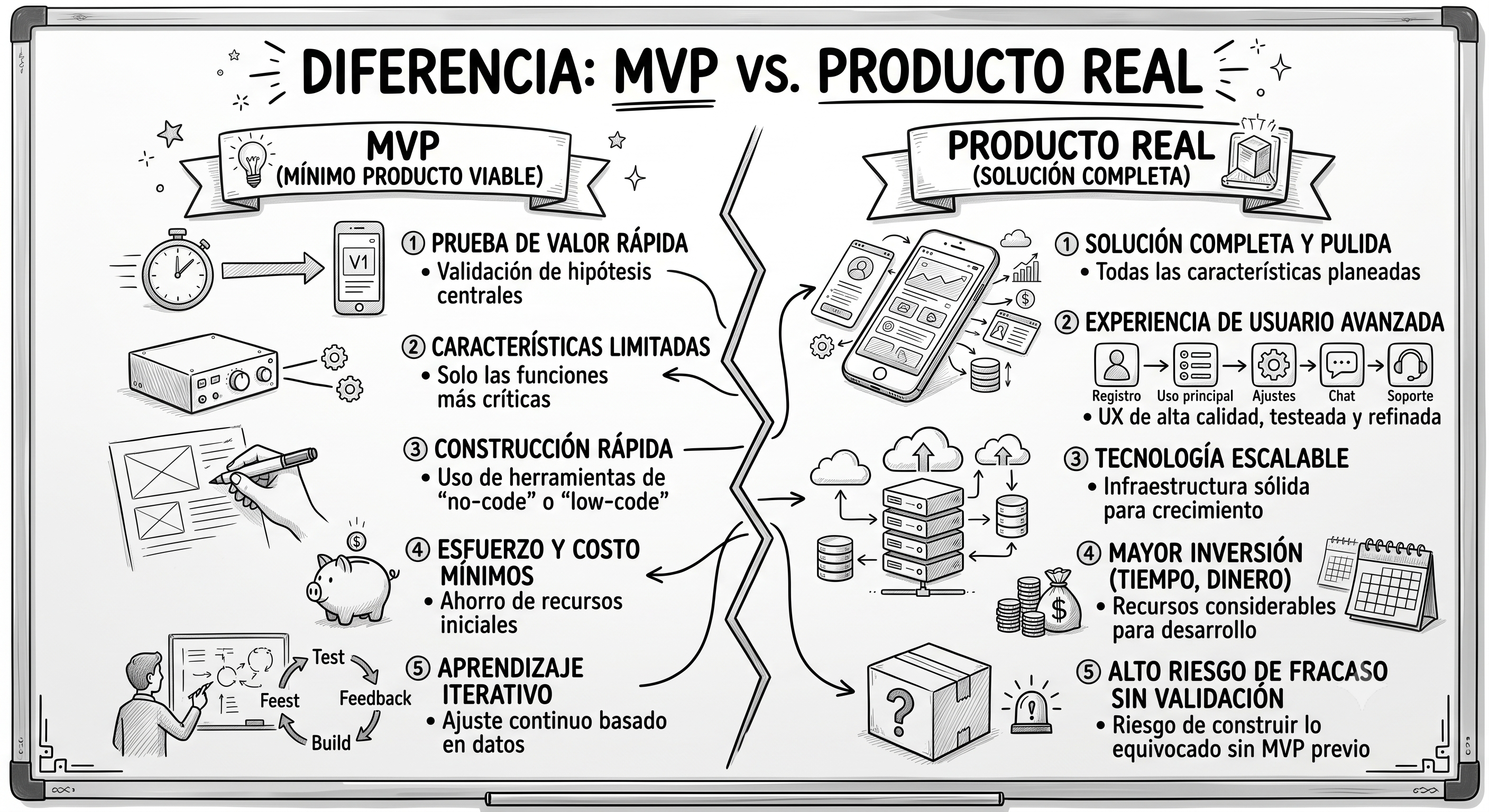
Is an MVP a real product?
And after all this, the big question arises... so is a minimum viable product the same as a real product?
Well, since selling smoke and mirrors is not my style, I have to tell you yes... and no.
A well-defined MVP has the capacity to be functional, to generate a good user experience, to have a technological infrastructure supporting it, and even to increase your company's income statement.
However, it will always be an MVP, and let me explain: creating products and services and launching ideas to the market is a much more complex process that an MVP will hardly ever fully cover.
The reality of a product is that you have to evaluate and cover things like security, ensuring all flows and processes work, making sure the infrastructure has no flaws, guaranteeing a reliable purchase process, making your system scalable... In short, I could detail an infinity of aspects that must be taken into account when turning your idea into a real product.
And it is for this last reason that I tell you to be very careful when considering your MVP a final product. I am going to ask you a series of questions that might help clarify what I mean.
Can you launch a product to the market without the security layer?
Yes you can, but you shouldn't. Imagine your product becomes very popular. There will be bad actors trying to hack your system.
Then a spin-off question arises... does an MVP need to be secured? Honestly, I think not to the level a cybersecurity expert would demand, but enough so that, for example, your company's income statement isn't defrauded due to malicious use of your system.
Can you launch a product to the market that is not scalable?
Yes you can, but you shouldn't. If your product or service becomes very popular, your infrastructure will need to be able to support all those users without the service suffering. Imagine visiting Google and having it not work; you might never visit it again.
And then comes the offshoot... Where is the limit of an MVP's scalability? And, I'll be honest again, you or your team decide the limit. In my personal experience, I don't know of any products or services where there isn't a process of constant evolution, having to rebuild features along the way because they weren't considered from the beginning—perhaps because at that launch moment it simply didn't make sense to consider those situations.
Can you launch a product to the market that does not have an associated business model?
Yes you can, but you shouldn't. I am a fairly altruistic person, I assure you, but turning an idea into reality, no matter how small it may seem, requires such a huge effort on so many levels that, from personal experience, I tell you that you do not want to find yourself working for free for everyone or, worse yet, losing money yourself.
The MVP helps in the process of creating products and services
Ultimately, as you will have seen, an MVP is the best ally to innovate in businesses, launch your idea to the market, or create a new product or service.
Undoubtedly, a minimum viable product is an impressive asset for managing the uncertainty derived from launching any idea. An MVP allows ideas to move forward and become reality, makes your product or service evolve in a more or less agile and, when well managed, sustainable way. Furthermore, it is a wonderful tool to foster innovation in any business.
But as I was saying, you have to know how to manage the entire process of creating a minimum viable product; evaluating the effort it entails and the reward it is capable of providing is just as important as measuring the expectations of this strategic asset.
Therefore, if you have an idea in mind, go ahead and build an MVP, because the "worst" that can happen is that you learn a lot along the way, and that learning will turn out cheaper than starting to develop a real product from scratch with all its implications and without the certainty that such a product or service will actually bring value to either the market or the users.