"I'm no good at coming up with ideas, I'm not a creative person..." Do you resonate with that phrase? Or perhaps you've simply arrived at this post because you want to go a step further and understand how to find inspiration for a project or business that's been lingering in your mind. Inspiration... that concept as ethereal as it is essential in any self-respecting innovation or entrepreneurial process, and so necessary to turn business ideas into real products and services capable of bringing value to the market.
The first thing I feel compelled to tell you is that, if you don't consider yourself a creative person, you are wrong. We can all be creative; every single one of us has the capacity to find in inspiration that spark of genius that allows us to conceive new things. The problem is that school, university, or academies do not teach us how to work on inspiration, and because of this, we mythify it and assume it is only within reach of a chosen few.
What is inspiration?
But you know what? It's normal for you to think that inspiration isn't for everyone. It is a concept that is not always easy to explain, or at least to rationalize. If you ask Artificial Intelligence—that all-knowing entity—it will tell you something like this:
Inspiration is a state of sudden clarity and creativity that drives a person to create, act, or solve problems. It is a sort of emotional or intellectual "spark" that motivates us to materialize ideas, closely associated with the work of artists, writers, and scientists.
It seems quite obvious that under this description, inspiration depends on things like clarity, creativity, and a series of sudden impulses... But well, in this article (and the accompanying video) I will explain how you can find inspiration because, believe it or not, inspiration can be cultivated through very simple concepts.
How can you find inspiration?
Yes, inspiration can be worked on. Inspiration when it comes to generating ideas, solving problems, or creating new products and services is the result of a structured process. I assure you that for inspiration to reach you, it is not necessary to go on a spiritual retreat, smoke something strange, or look for shortcuts. It is enough to follow a series of logical steps that will prepare your mind to connect the dots that will help you create whatever you set your mind to.
I have spent more than twenty years generating simple solutions to complex problems, and one of the fundamental aspects of working on inspiration is being able to understand our most powerful tool: our brain. If you are unable to understand how it works, it will be very difficult for you to train it to approach problem-solving in a professional way.
What is the formula for inspiration?
Inspiration depends on four fundamental concepts that, when worked on properly, will turn your brain into a perfect creative machine capable of generating ideas endlessly. In fact, Pablo Picasso already said it: "If inspiration exists, may it catch me working."
And the four ingredients we need to work on to foster our inspiration are the ones I show you in this diagram and detail below:
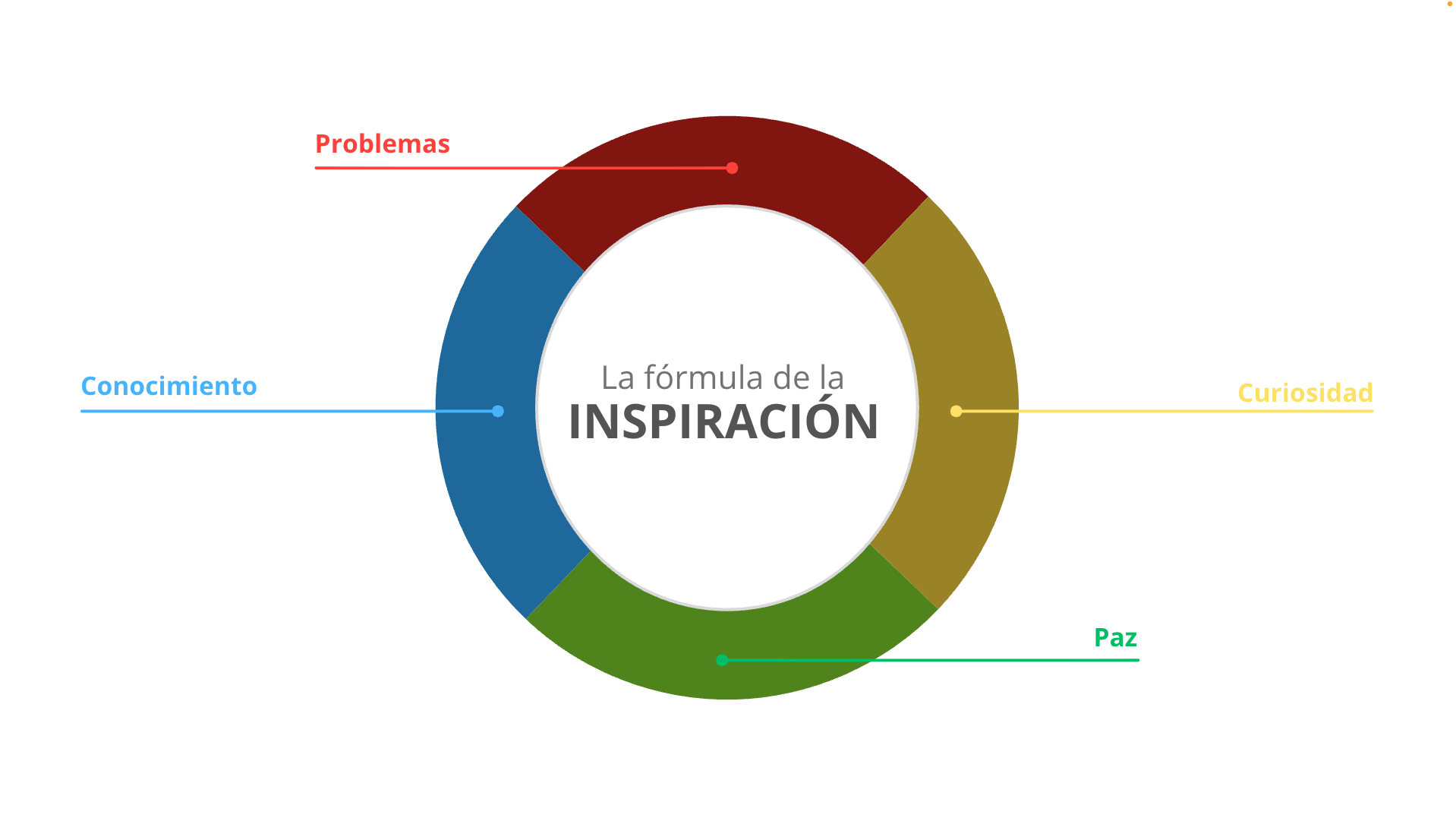

Problem detection
The brightest minds are not brilliant just because. While I believe there is an innate point of genius in everyone, the most brilliant minds are usually those with an almost obsessive capacity to observe their surrounding environment in a constant search for problems to solve.
Imagine you want to start a new business or propose an idea for a project at your company. In both cases, you will need to be very observant and learn to detect problems that can be good opportunities. Store all that information in your brain because, believe it or not, your mind needs all that information to be safely tucked away for when it is needed.
Acquiring knowledge
If problems are the fuel your mind needs to ignite the flame of inspiration, knowledge is the tank that will allow you to stay in control in the face of any problem. It doesn't matter the sector in which you need to create or innovate; the greater your knowledge of the problem you have detected, the closer you will be to having inspiration sprout on its own.
Genuine curiosity
It is very difficult for inspiration to occur if you do not have genuine curiosity as a driving force for everything you need to do to turn your idea into reality. Be curious enough to fully understand problems, and you will see how inspiration emerges almost inevitably along that path.
Peace of mind
But undoubtedly, the concept where many people fail and the reason why inspiration never crosses their path is peace of mind. The society we live in bombards us with constant stimuli; our day-to-day problems do not allow us to stop and think about anything other than solving the next immediate issue to stay afloat.
This is why I suggest that, if you have worked on the previous three concepts, you allow yourself to stop. Dedicate some time to a contemplative life and to "not thinking"; this will leave space in your brain to connect the dots, and that is where inspiration, ideas, and genius arise.
Why do the best ideas come to you in the shower?
Has it ever happened to you that while taking a shower, walking in the park, or working out, that brilliant idea you had been looking for for days suddenly hit you? People often believe that profiles like mine (product designer) are like enlightened beings. However, nothing could be further from the truth. Innovation is not magic; it is fundamentally the result of applying structured processes.
How to unlock creativity?
Many of the workshops I have conducted throughout my career are based precisely on this cycle: we bombard the brain with critical information during the working session, and afterwards, I tell everyone to go rest, take a walk, and disconnect.
The result? In the next session, solutions appear naturally and "as if by magic." There are no mystical shortcuts. If you are able to integrate these four phases into your routine, you will be able to create innovative ideas consistently. Innovation is a muscle trained with method, observation, and above all, moments of calm.
How do geniuses find inspiration?
If I am telling you all this, it is not on a whim. I am just a drop of water in the ocean of the creative world, but those we all consider great creative geniuses followed this exact process. Steve Jobs, for example, was very fond of going for walks in search of inspiration. If you want to know more about his methodology, I recommend this analysis on the secret behind Steve Jobs' success.
Inspiration can be cultivated
Therefore, the next time you find yourself blocked facing a design or business problem, do not despair thinking that you are not creative or that inspiration won't come to you. Ask yourself: Have I analyzed the problem thoroughly? Do I have the necessary knowledge? Have I been curious enough? And finally, am I giving myself the necessary mental peace so my brain can work?
Turning ideas into reality is a trainable process. You are one step away from diving deeper into your vocation, just as I explain in my post about what a Product Designer actually does. If you are willing to understand how your mind works and learn to control it by applying this process, inspiration and creativity will simply be the "natural consequence" of a job well done.